
High mileage oil costs about $5 to $15 more per change and earns that money once an engine past 75,000 miles starts seeping at the gaskets or burning a noticeable amount of oil between changes. If your engine is bone dry and the dipstick barely moves in 5,000 miles, regular oil in the viscosity your manual calls for is still the honest buy.
On this page: What it does The honest test When to skip it Cost Switching FAQ
What High Mileage Oil Actually Does
Strip away the marketing and high mileage oil is regular oil with three additions: seal conditioners that swell and soften aging rubber gaskets, extra detergents to clean up deposits, and in many blends a bit more anti-wear additive. The seal conditioners are the part that matters. Valve cover gaskets and crank seals shrink and harden with age, and that is where the drips and seeps start.
What it does not do is fix metal. Worn piston rings, scored cylinder walls, and stretched timing chains do not care what is printed on the jug. I have seen plenty of invoices where a shop sold the premium oil as if it were an engine treatment. It is not. It is a modest gasket helper at a modest price, and on the right engine that is enough.
The Honest Test: 3 Signs It Is Worth It
Skip the odometer worship. The number on the jug says 75,000 miles, but the real test is what your engine is doing, not how far it has gone. Here is the test I would run on my own truck.
One: there are drops on the driveway or a damp film around the valve cover. Seal conditioners can slow a seep like that, and $10 a change beats a gasket job. Two: you are adding a quart or more between changes. Some of that burn is oil sneaking past aging valve seals, which the seal conditioners can help. Three: consumption is creeping year over year. Catching that early is exactly what the additive package is for.
Hit one of those three and the upgrade pays for itself. Hit none and you are buying peace of mind, which is a legitimate purchase, just an optional one.
When to Skip It
If your engine does not leak, does not burn, and runs the oil your manual specifies, changing to high mileage oil at 75,001 miles accomplishes nothing except a slightly larger invoice. Modern engines routinely run past 200,000 miles on regular oil changed on time. The interval and the viscosity do the heavy lifting, and our oil change interval guide in the list below covers both.
Watch for the quick lube version of this pitch: your odometer crosses 75,000 and the service writer reaches for the premium jug automatically. That is an upsell, not a diagnosis. Ask what they saw: a seep, a low dipstick, anything. If the answer is “it is recommended at this mileage,” you are free to decline. The FTC’s auto repair basics page is a good primer on saying no politely.
One thing that never changes: viscosity. High mileage or not, use the weight your manual calls for. Our 5W-30 vs 5W-20 guide explains why the manual wins every argument.
What High Mileage Oil Costs
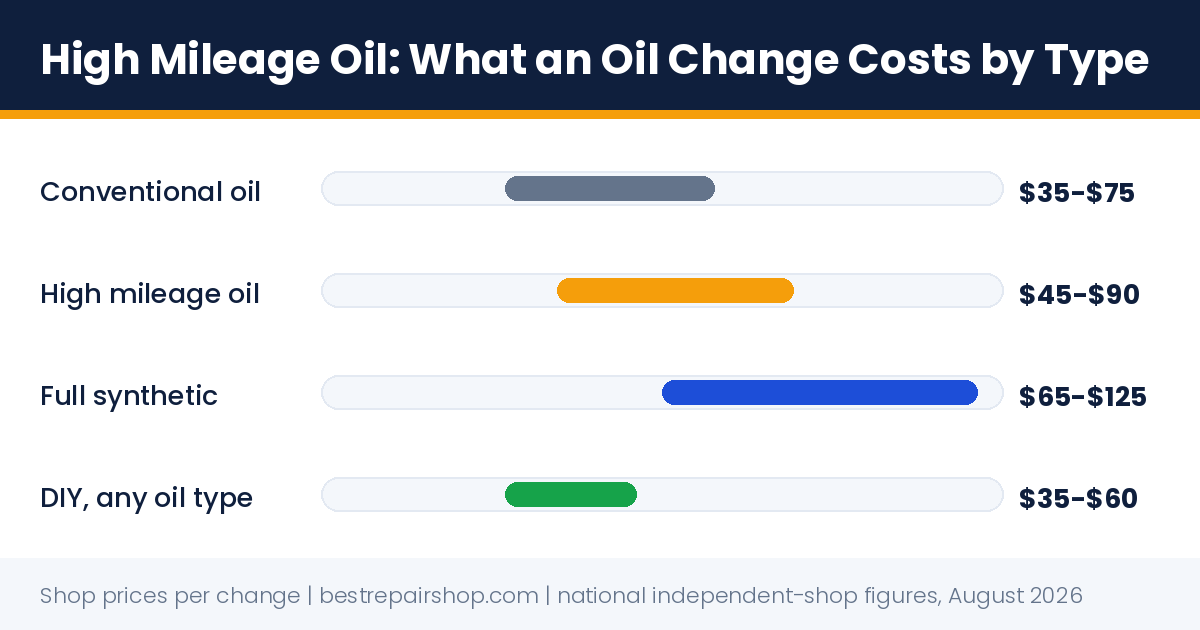
The premium is small. At the counter, a 5-quart jug of high mileage blend runs a few dollars over the regular version of the same brand. At the shop, expect the change to land between conventional and full synthetic prices.
| Oil change type | Fair shop price | Notes |
|---|---|---|
| Conventional | $35-$75 | Baseline |
| High mileage blend | $45-$90 | Usually $5-$15 over baseline |
| Full synthetic | $65-$125 | High mileage synthetic at the top of range |
| DIY, any type | $35-$60 | Oil plus filter |
Ranges are national, independent-shop figures, August 2026. If a shop quotes the full synthetic price for a high mileage blend, ask which product is actually going in the engine. The jug should answer for itself.
Switching, Mixing, and Switching Back
Switching to high mileage oil requires no ceremony: drain, fill, done. It mixes safely with regular oil of the same viscosity if you need a top-up quart on the road, and you can switch back any time without harming anything. The seal conditioners simply stop doing their job, and a slowed seep may return over the following months.
If you do your own changes, nothing about the process is different, and the premium shrinks to pocket change. Our step-by-step oil change guide covers it. And keep one habit either way: check the dipstick monthly on any engine past 100,000 miles. An engine that burns oil quietly is how a $10 quart problem becomes the day the oil pressure light comes on.
FAQ
Is high mileage oil worth it if my car has no leaks?
Not really. With no seeps and no consumption, the seal conditioners have nothing useful to do, and regular oil at the correct viscosity protects a healthy 100,000-mile engine just fine. Spend the difference on changing it on schedule instead. That habit is worth more than any additive package.
Can it stop an existing leak that has already started?
It can slow a seep from a hardened gasket, and sometimes that is enough to stop drips entirely. It cannot fix a torn gasket, a cracked seal, or a mechanical failure. If you are losing more than a quart between changes or see a puddle rather than a spot, price the actual repair.
Is it synthetic or conventional oil?
Both exist. Most jugs on the shelf are synthetic blends, and every major brand also sells a full synthetic high mileage line. The high mileage label describes the additive package, not the base oil. Match the base oil and viscosity to what your manual requires, then pick the additive package.
Does it hurt anything to use it early, before 75,000 miles?
No. The seal conditioners are gentle on healthy gaskets, and the extra detergents do no harm. You are simply paying for insurance you do not need yet. On a younger engine the money does more good in a slightly earlier change interval than in a premium jug.