
Real car maintenance is a much shorter list than the service menu at the counter. This page covers the maintenance that genuinely protects your engine and your wallet, the fair price for each service, and the add-ons you can confidently skip.
On this page: What matters Oil Timing belt Skip these Mileage packages Do it yourself By season Guides FAQ
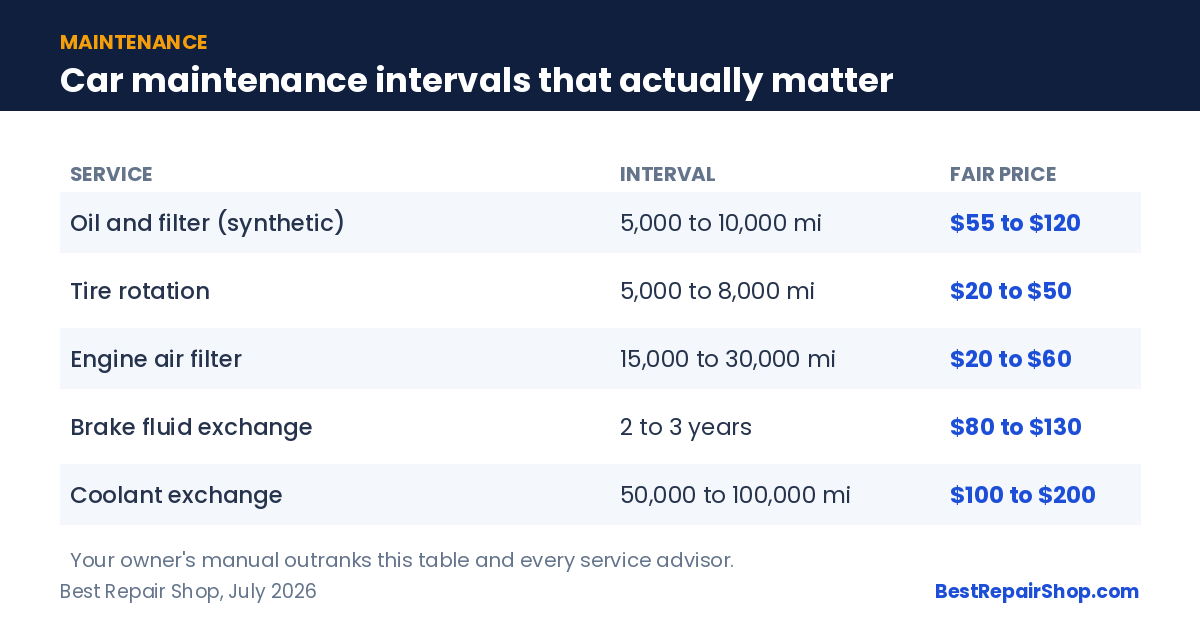
The car maintenance that actually matters
| Service | Typical interval | Fair price |
|---|---|---|
| Oil and filter change (synthetic) | 5,000-10,000 miles | $55-$120 |
| Tire rotation | 5,000-8,000 miles | $20-$50, often free with tires |
| Engine air filter | 15,000-30,000 miles | $20-$60 |
| Cabin air filter | 15,000-30,000 miles | $20-$70 |
| Brake fluid exchange | 2-3 years | $80-$130 |
| Coolant exchange | 50,000-100,000 miles | $100-$200 |
| Transmission fluid change | 30,000-60,000 miles (check your manual) | $100-$250 |
Your owner’s manual outranks this table and every service advisor. The manual’s “severe service” schedule only applies if you actually drive that way: lots of towing, dust, or short trips in extreme heat or cold.
Oil: the one everyone argues about
Oil is the biggest maintenance topic on the internet and the one with the most myths. High mileage oil, full synthetic versus blends, 5,000 versus 10,000 mile intervals: our flagship oil guide is in the works and will settle each question with data instead of folklore. Until then, the short version: follow the manual’s interval, use the grade printed on the oil cap, and know that “synthetic” on the menu should cost $55-$120, not $200.
The one interval you cannot let slide
Most car maintenance you can be a few thousand miles late on without consequence. The timing belt is the exception. On an interference engine, a snapped belt lets the valves and pistons meet, and the repair bill stops being maintenance and starts being a rebuild.
First find out which one you have. A timing chain is designed to last the life of the engine and needs no scheduled replacement. A timing belt is rubber, and manufacturers list a hard interval, usually 60,000 to 105,000 miles or seven to ten years, whichever comes first. The age half of that rule catches people out, because a belt dries and cracks whether you drive the car or not.
Expect $500 to $1,100 for a belt job on a common four-cylinder, more on a V6 where the engine has to come apart further. Have the water pump, tensioner, and idlers done at the same time. They sit behind the same covers, the parts are cheap next to the labor, and doing them later means paying that labor twice.
Services you can usually skip
Some services exist mostly to pad the ticket. An “engine flush” on a healthy engine that has had regular oil changes is rarely needed. Fuel injector cleaning as a routine add-on does little that quality gas has not already done. And the transmission flush deserves its own conversation, because the right answer depends on your car’s history: Do you really need a transmission flush?
The pattern to watch for: a service recommended by the printout instead of by a measurement. Ask “what did you measure on my car?” and watch what happens. One more protection worth knowing: a shop or dealer cannot void your warranty just because you had routine maintenance done elsewhere, and the FTC’s auto repair guidance spells out where the line actually sits.
The 30/60/90k package, unbundled
Dealers sell mileage-interval packages as a single price: the 30,000 mile service, the 60,000, the 90,000. Some of what is inside is genuinely scheduled car maintenance. The rest is inspection time and add-ons priced as though they were repairs.
Ask for the package broken out line by line, then cross off anything your manual does not list at that mileage. A $600 “60,000 mile service” often collapses to an oil change, a transmission fluid change, two filters, and a brake fluid exchange, which is $300 to $400 of real work at an independent shop. You are not refusing maintenance by unbundling it. You are refusing to pay repair prices for a checklist.
Watch for the same item appearing in two packages within 30,000 miles, and for “inspect” lines billed at an hour each. An inspection that happens while the car is already on the lift for an oil change should not carry its own labor charge.
Twenty minutes of car maintenance you can do yourself
None of these need tools beyond your hands and none of them can hurt the car if you go slowly. They are also the four items shops mark up hardest, so the savings are real.
| Job | Part cost | Shop charges | Time |
|---|---|---|---|
| Cabin air filter | $15-$30 | $50-$90 | 5 minutes |
| Engine air filter | $15-$35 | $40-$70 | 5 minutes |
| Wiper blades | $20-$45 a pair | $50-$90 | 5 minutes |
| Tire pressure check | Free | Free, if you ask | 5 minutes |
Set the tire pressure cold, before you have driven, and match the sticker in the driver’s door jamb. Correct pressure is the cheapest safety and fuel economy you will ever buy.
Car maintenance by season
Cold weather is a battery’s stress test. A battery that starts the car fine in October can fail on the first hard freeze, because cold thickens oil and cuts available cranking power at the same time. Most shops test batteries free, so ask before winter rather than after a no-start.
Heat is harder on cooling systems, belts, and tires. Tire pressure moves roughly one PSI for every ten degrees of temperature change, which is why the TPMS light shows up on the first cold morning of autumn. Check pressures monthly against the sticker in the driver’s door jamb, not the number on the tire sidewall, which is a maximum rather than a recommendation.
Start with these guides
- How often should you change your oil? Honest answers for 2026
- How to change your own oil in 9 simple steps
- How to change a tire in 8 safe steps
- How to jump start a car: 7 safe steps in the right order
- How long do tires last? 6 honest signs yours are done
- Do you really need a transmission flush? How to tell before you pay
Maintenance questions, answered straight
Did I really need the $80 cabin air filter?
You needed the filter eventually; you did not need the markup. The part costs $15-$30 retail and takes minutes to swap on most cars. It is one of the easiest DIY wins there is, and a fair shop charges modestly for it.
Is skipping one oil change a big deal?
Going a little past the interval once will not kill a modern engine. Making a habit of it is how sludge builds, and sludge turns a $70 service into a four-figure repair. Set a reminder and stay boring; boring is cheap.
Does dealer maintenance keep my warranty valid?
It is not required. Keep receipts for whatever work you have done and wherever you have it done, and your warranty stands. Dealers are a fine choice, but they are a choice, not an obligation.
Should I trust the oil life monitor or the mileage sticker?
Trust the monitor. It is not a mileage countdown; it models engine temperature, trip length, load, and rpm to estimate how much life the oil has left. The sticker on your windshield was printed by whoever changed the oil and usually reflects their preferred return date. When the two disagree, the car knows more than the sticker.
How much car maintenance should I budget per year?
For a vehicle out of warranty, $600 to $900 a year covers routine work for most drivers, and setting aside another $500 for the repair that eventually arrives keeps a bad week from becoming a credit card balance. Older or higher-mileage cars run above that. Budgeting for it in advance is what turns a breakdown into an inconvenience.
Already been handed a service list?
Take the list, look up each item’s fair price on the cost guides, and read how to find a good mechanic to learn which questions separate real recommendations from menu padding.