
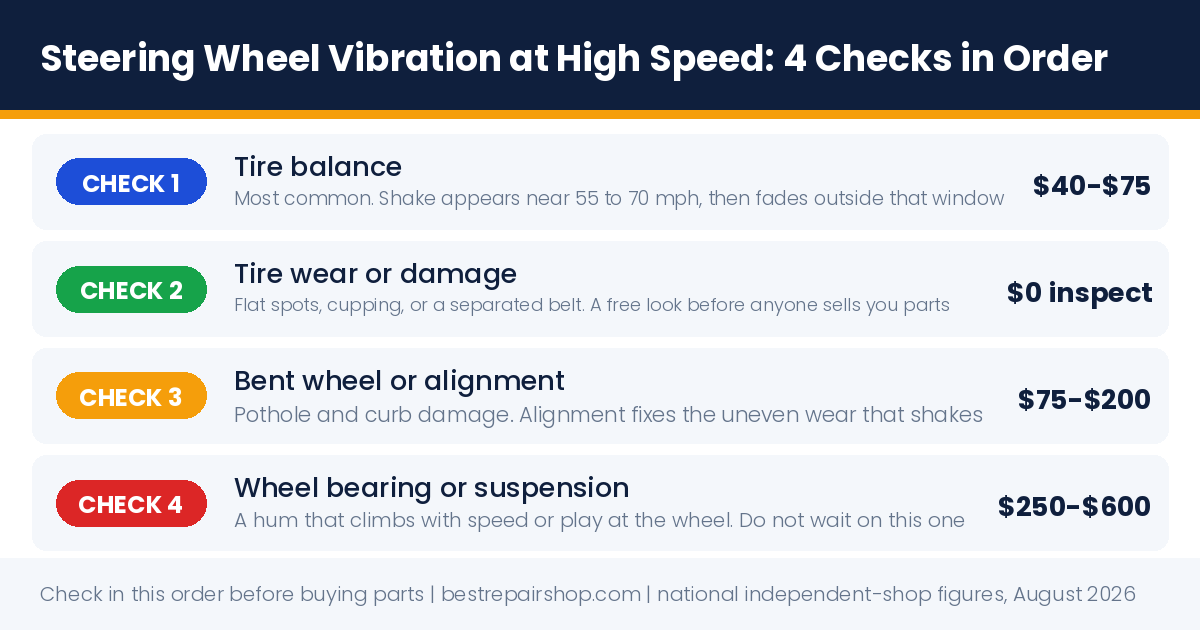
Steering wheel vibration at high speed is most often a tire balance problem, and the fix usually runs $40 to $75. The honest check order is balance first, then tire condition, then the wheel and alignment, and only then suspension parts like a wheel bearing at $250 to $600. If the shake shows up between 55 and 70 mph and fades above or below that window, balance is the smart first bet.
On this page: Causes Balance first Tire damage Wheel and alignment Bearing check Costs FAQ
What Causes Steering Wheel Vibration at High Speed
Your car is talking to you, and a shake that only shows up at speed is one of its clearest sentences. Almost everything that causes steering wheel vibration at high speed is something round that is no longer spinning true: a tire, a wheel, a hub. The faster those parts spin, the harder a small imperfection hits your hands.
The good news is that the causes sort themselves by price, and the cheapest one is also the most common. A vibration at 70 mph that was not there last month is usually a $40 to $75 balance job, not a suspension rebuild. The four checks below run from most likely to least likely, and a good shop works them in the same order.
Check 1: Tire Balance, the $40 to $75 Fix
Wheel weights fall off. Tires wear unevenly. Either way, one corner of the car ends up a fraction of an ounce heavy, and at highway speed that tiny imbalance turns into a rhythmic shake. The classic signature: it starts around 55 mph, peaks near 65 to 70 mph, and smooths out above that. If your steering wheel vibrates in that speed window and nowhere else, ask for a balance before anything more expensive.
Expect $10 to $20 per tire at most independent shops. If a standard balance does not cure it, a road force balance, usually $25 to $50 more, presses a roller against the spinning tire and finds stiff spots a normal balancer misses.
Check 2: Tire Wear and Damage
If balancing does not fix it, the tire itself may be the problem. Flat spots from hard braking or long parking, cupped wear from skipped rotations, and a separated internal belt can all shake the wheel. A separated belt often announces itself with a wobble at low speed too, and it is a safety issue, not a comfort issue. Replace that tire, do not balance it.
This check is free: a tech spins each wheel and watches for hop or wobble. While you are there, check age and depth. Tires are worn out at 4/32 inch by the quarter test, and 6 years is a typical lifespan with 10 the maximum. Our guide to how long tires last covers both checks, and NHTSA’s tire safety resources are worth a bookmark.
Check 3: Bent Wheel or Alignment
Potholes and curbs bend wheels, and a bent wheel cannot spin true. The balancer reveals this too: a tech watching runout can spot a bent rim in seconds. Straightening runs about $75 to $150.
Here is the honest part most shops skip: alignment itself rarely causes vibration. Bad alignment causes a pull and uneven tire wear, and it is that uneven wear that eventually shakes the wheel. So an alignment, typically $75 to $200, stops the problem from coming back, but the worn tires may still need attention today.
Check 4: Wheel Bearing and Suspension
If the first three checks come up clean, it is time to look at parts that hold the wheel: the wheel bearing, tie rod ends, and ball joints. A failing bearing usually hums or growls, and the pitch climbs with speed. If you are hearing that soundtrack along with the shake, read our guide to wheel bearing noise and get it checked soon.
Worn tie rods and ball joints let the wheel shimmy instead of tracking straight. A tech confirms them by rocking the lifted wheel and feeling for play. One more clue worth sorting out: if the shake only happens when you brake, that is a different story, usually rotors, and we cover it in car shakes when braking.
What Each Fix Costs
Here is the fair-price picture for steering wheel vibration at high speed, from the most common fix to the least common.
| Fix | Fair price | How often it is the answer |
|---|---|---|
| Tire balance, all four | $40-$75 | Most cases |
| Road force balance | $65-$125 | Stubborn cases |
| Tire replacement, each | $100-$250 | Damage or wear |
| Wheel straightening | $75-$150 | Pothole damage |
| Alignment | $75-$200 | Prevents repeat wear |
| Wheel bearing, per wheel | $250-$600 | Rare, with noise |
Ranges are national, independent-shop figures, August 2026. If a shop jumps straight to bearings or struts without balancing first, ask them to walk you through what they ruled out and why.
FAQ
Is it safe to drive with steering wheel vibration at high speed?
For a few days while you book a balance, usually yes. But a shake that gets worse quickly, comes with a growing hum, or arrives after a hard pothole hit deserves a same-week look. A separated tire belt or a failing bearing can turn into a roadside emergency, and both start out feeling like a minor vibration.
Why does my steering wheel vibrate at 70 mph but not at 60?
That narrow speed window is the fingerprint of imbalance. Every rotating assembly has a speed where its heavy spot resonates, and for most passenger tires it lands between 55 and 70 mph. Above or below that, the vibration is still there but too small to feel. Start with a balance.
Can a bad alignment cause the vibration?
Only indirectly. Alignment problems cause a steady pull toward one side and choppy, uneven tire wear. That worn tread is what shakes the wheel later. If your car pulls and vibrates, plan on tires or a balance now and an alignment to protect the new rubber.
Why does the whole car shake instead of just the wheel?
Feel it mostly in the steering wheel, and the problem is likely up front. Feel it in the seat and floor, and look at the rear tires or driveshaft. It is a genuinely useful clue, so mention it at drop-off.